

About The Episode
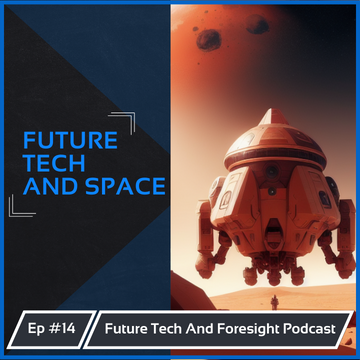
A brief look at the future of space travel and how different automation technologies will impact it as well as the jobs that support the industry.
Additional Notes:
A good documentary on the young generation training to go to Mars: https://g.co/kgs/pmoG7s
Transcript
So this week’s episode is going to be a little bit lighter, shorter and a bit more speculative to contrast last week’s heavier episode. As I mentioned last week, we’ll look at the space industry which has had a surge in hype over the last few years, mostly fueled by SpaceX’s reusable rocket successes but also due to the ever growing number of powerful parties entering the new space race, like Amazon’s Jeff Bezos with the Blue Origin Project.
But before jumping into this, I wanted to bring up two recent pieces of news that connects back to the episodes on AI and Virtual reality.
First off you may have heard that last week, Lee Se-dol the 18 time world champion of Go retired, attributing his retirement to the now unbeatable AI programs. Since his 5 match showdown with Google’s AlphaGo in 2016, the AI system has only gotten more powerful and competent at playing the game, and has beaten other top players across the world. Though Chess has already been a machine’s game for a few decades now, its popularity has actually grown. However this doesn’t seem to be the perspective that everyone takes, and the sense of pointlessness certainly has overtaken the Go champion.
The second piece of news is a little more comical, or creepy depending on your point of view. A Russian dairy farmer has given his cows specially designed VR headsets which simulate a peaceful summertime field. This apparently reduces anxiety, improves a cow’s emotional mood, and boosts milk production and even quality. Personally I think it’s a rather unique application of VR headsets that I would never have thought of. But also I’m a little worried that it would be used to mask, or help legitimize some of the horrific experiences that animals undergo in industrial agriculture. But nonetheless thought it was something interesting to share.
But moving onto the future of space.
The global space industry is currently valued to be over 400 billion USD, and though exact figures are a challenge to come by, it is estimated to employ roughly 1 million people across the globe. This includes the manufacturing of vehicles and satellites that go into space, their launch, and all the services related to it. This also includes research and development as well as the emerging space tourism industry. Starting with the first object in space, the Soviet Union’s Sputnik 1 on October 4 1957, we now have just under 5000 satellites in space, while only half of them are operational, with only 7 revolving around other planets. 382 objects were launched into space in 2018, and it is expected that even more will be sent in 2019. However, there are 13,000 items in orbit from the International Space Station, the Hubble Space Telescope, a Tesla car, to dead satellites and used up rocket stages to chunks of metal or bolts and screws that have fallen off launched satellites. But, there are estimated to be over 128 million pieces of debris smaller than 1cm, which includes bits of paint, and plastic…it’s not just our oceans that are contaminated with the stuff. Now, we also have the New space industry, or the emerging private spaceflight industry. Independent from governments or traditional major contractors and are typically driven by commercial interests, rather than political ones, like the space tourism mentioned before. This will greatly increase the number of people going to space and to the moon and possibly even Mars. As of late 2019, only 565 people have ever gone into space since the soviet cosmonaut Yuri Gagarin completed one orbit around the earth in his Vostok 1 capsule on April 12 1961. And only 12 of those have walked on the moon. It’s pretty clear that we are still in the early days of human space exploration, however, our personal involvement in space travel might be more limited than previously thought.
In the first robotics episode of this podcast – we covered the advancing state of automation in manufacturing which also included the production of satellites and space vehicles. Though it’s a challenge to know what percentage of the roughly 1 million people involved in the space industry account for the manufacture and production of the objects put into space, the advancing state of robotics and industrial technologies will certainly influence human involvement in the making of these complicated parts. However, this might be offset with the continued expanse of the space sector as mentioned at the start of this episode. With the New Space industry leading the renewed interest in space exploration the expanded investment will necessitate the need for more people to be involved in all areas.
Space Debris
One area of particular issue in the space industry is the growing amount of space debris. There is actually something called the Kessler syndrome which hypothesizes that due to the already large amount of space debris the collisions between the objects, especially in the low orbit of earth, could cascade to a point where each collision would generate further debris which increases the chance of other collisions. The main consequence of this is that it would inhibit or damage the current operational satellites and even make future launches problematic. One of the ways this is being dealt with is though Researchers of mechanical, aerospace and nuclear engineering at Rensselaer Polytechnic Institute in New York. They are developing an autonomous garbage collector called OSCaR, that would cheaply use a system of trackers and nets to de-orbit a few space debris objects per mission before returning to earth. The objective would be to send fleets of these autonomous collectors into space where they could coordinate and begin cleaning the earths orbit of the hazardous objects.
Space exploration
Space exploration has predominantly being by use remote controlled or pre-programmed probes or robots. Most notably, of course is the Mars Rover. Only 4 of the 6 Mars rovers were ever functional, and it was only the most recent one, Curiosity, that had an autonomous system in it. It is still functional today, and continues to search for environmental conditions favourable for microbial life, including the presence of water on Mars. Though this car sized robot had a mission length of 2 years, it is now into its 8th year of operation, and doesn’t appear to show signs of failing yet. So we are already using robotic autonomous space exploration technology. Another example is the Boeing X-37B – which is a space shuttle like vehicle (1/4 the size of the original man operated space shuttle) that is completely robotic and reusable, with the purpose to return experiments to Earth for further inspection and analysis. It is not such a speculative leap that such a vehicle could be expanded in size and used to transport people however.
To this point, one of the most well known New Space companies out there is SpaceX led by Elon Musk, and very publicly expressing the desire to create a base on Mars to precipitate the colonisation of the red planet. If this continues to capture the public imagination we will most probably see a trickle, and then a flood of migration to mars, which may be supported by automated systems that are more reliable and efficient, enabling the 2 planet species desired by many. There is a good Netflix documentary called the Mars Generation that looks at a group of teenagers who are training to become future engineers and astronauts with hopes of leading mankind’s journey to Mars, in case you were skeptical if this vision would be attractive to anymore. But, most notably Elon Musk has explained numerous times how important this migration is in order to improve the chances of humanity to survive over time. If another asteroid that hit earth 65 million years ago were to hit earth again today, it could have similar catastrophic effects on our civilisation comparable to the extinction of the dinosaurs. To this end, there have already been over 50 missions to Mars, with roughly half only being successful, all with probes, satellites, or robots of some sort. There are currently 6 satellites orbiting Mars constantly streaming back data about the planet, and many more missions are planned for the coming decade, and there are proposals for manned missions for the 2030’s. Whether these eventually come to pass isn’t guaranteed, but it appears that the continued use of automated systems to explore at least our solar system will continue.
Future Autonomous Space Exploration
However, when it comes to more distant space exploration, more speculative predictions exist. The most prevalent is that of building a self-replicating robot on the moon that could launch and travel and explore while sending back data. These are called von Neumann probes could land at any asteroid or other similar moon, build other ‘clone’ drones and expand the discovery of space. This of course entirely removes the human element for space exploration. Nasa even commissioned a study back in the 1980’s to look into advanced automation for space missions, and one scenario was to build a self-replicating manufacturing factory on the moon. Though the plan never materialised, in 2017 Canadian researchers built a self -replicating 3D printer that could work only using materials from the moon. So though the idea was originally quite speculative, it might be more feasible than originally thought of.
Neil deGrasse Tyson my favourite public personality when it comes to all things space related has discussed this before and makes it clear that if we care about scientific discovery and advancement, there is no argument, using robots to explore space is the only option. It is cheaper on a scale of 100 to 1000x to send a robot, there is no threat of death, no need for food or any of the other dozen issues when sending humans to space, and much more information can be gathered by an autonomous smart robot system. However he makes the cultural and inspirational argument for having humans in the frontiers of exploration in order to motivate others to join the pursuit of space exploration/travel. Robots most probably won’t inspire new generations of explorers as much as a human space explorer would. But nevertheless, whether we are talking about future speculative space exploration or very near term Mars colonisation, autonomous systems will play a massive role in the space industry. I personally don’t see robots taking over in this domain, as the sense of adventure and exploration into the unknown seems to be something that has motivated us for hundreds and thousands of years. But I think i’ll wait until both a base and a shorter inexpensive return trip are available before visiting Mars.
That’s it for this week, next time we’ll look at something a little more terrestrial in the sharing economy and how it has already been impacting us and what the future of it looks like.