

About The Episode
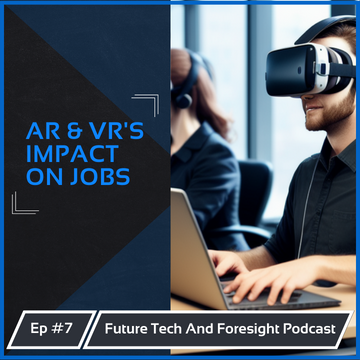
This episode looks at how both Augmented and Virtual reality will impact jobs in the future as well as today. Current applications are looked at too.
Additional Notes:
VR games centre in Eindhoven (NL) : https://www.enversed.com/en/welcome/
First Virtual reality system Sensorama: https://en.wikipedia.org/wiki/The_Sword_of_Damocles_(virtual_reality)
Nasa’s VR system : https://www.nasa.gov/ames/spinoff/new_continent_of_ideas/
Dystopian Google Glasses video: https://www.youtube.com/watch?v=_mRF0rBXIeg
Transcript
Before getting into today’s topic on AR/VR I wanted to mention something really quickly, related to last week’s podcast. I was at a two day meeting this week and during the dinner I began talking to people with children of 2 and 5 years old. It was interesting to hear that other parents that they talk to expect that none of their kids will need to learn how to drive or even have a driver’s licence, it appears that the idea of automated transport is in the public zeitgeist.
So VR and AR are perhaps the techs that I am the least familiar with especially as to how it’ll impact jobs, mostly because I was never really impressed with the tech and saw it mostly as a yet another over-hyped technology which has had a decreased general public interest since it didn’t live up to its hype especially in the last couple of years. But I’ve had a pretty big change of heart only in the last few weeks, and this week especially as I went to a VR games centre as part of a team building activity for a project I help manage. I was completely blown away at how immersive the experience was. We played 4 games overall but 2 really stood for me. An archery based one, and some robot shooting one. With the archery one some large balloons kept coming closer and closer and you had to shoot them to pop them. If you missed then they came directly at you and I found myself pulling back a number of times feeling as if i’d be hit by these large balls. The robot shooting one was a ton of fun and made you really feel as if you were on a platform in space shooting a bunch of robots buzzing around trying to shoot you. Took me a minute or so to readjust to reality after I lost my 3 lives and the others I was playing with felt the same. I highly recommend anyone to test out at the very least some VR games if you’re interested in this technology. There are lots of VR arcades in most big cities nowadays. Also, there was another game based in a kitchen, and the game center’s staff member who was explaining the game to everyone reminded everyone not to place the controller on the kitchen counters which were just virtual and didn’t exist…. though this didn’t happen with anyone in my group apparently people in the past had been so immersed that they thought of placing the controller on the counter or even leaning on it obviously breaking controllers or falling down..
But this is 2019, and the technologies are relatively far advanced, let’s briefly look at where they came from
History
In 1962 Morton Heilig built a working prototype of something called Sensorama, which looked like a big box which you could sit down at, put your head in, and experience an immersive virtual reality video that also had the seat move, smells burst at you and even rushes of wind. Then at Harvard in 1965 Ivan Sutherland built the “Ultimate display” termed the Sword of Damocles it was the first virtual reality headset, though so heavy had to be suspended from the ceiling, and so primitive it simply showed wire-frame rooms. The 60’s and 70’s saw further development but it wasn’t until 1985 that NASA made a virtual environment workstation and VR was actually coined as a term. It was a head mounted system that doesn’t look too far off from what we have today, though still primitive and very bulky. VR was picked up by video game manufacturers like Sega and Nintendo in the early 90s but their products flopped and VR actually receded from mainstream focus, with research and development still continuing but with less effort as before. It wasn’t until 2012 that VR came back with a kick-starter campaign for the Oculus Rift, a headset predominantly used for gaming. This sparked a new VR wave with first Facebook buying Oculus for some 2 billion$ in 2014, and other big name brands like Samsung, Sony, Microsoft etc also entered the industry.
Moving to AR
Unlike VR which creates an entire digital reality, AR overlay’s and integrates digital data onto reality which can be anything from images, sounds, video, or additional data. Though AR’s initial steps are also the same as VR’s, augmented reality only really began in earnest in 1990 and was coined by a researcher Tom Caudell at Boeing to help workers with the manufacturing of airplanes by projecting schematics and the manufacturing process. AR didn’t gain real mainstream traction until 2013 with the failure of Google Glass which was discontinued in 2015 due to privacy fears (great video of these fears in the shownotes). AR was really brought to mainstream attention through a video game, Pokemon Go. Released in July of 2016, in less than a month it had over 100 million downloads. Now if you’re like me and have never played the game, essentially you walk around your city and depending on where you are a Pokemon creature can pop up and you have to try to catch it. The interesting part is that through google maps and your smartphone camera a digital world is overlayed onto the physical world This allows Pokemon to appear on sidewalks, in parks, next to churches or bus stops etc. You see the Pokemon through your phone while pointing the camera at the world around you making it look like they are actually in the real world. And different Pokemon appear in different geographical locations (near water, in open fields etc) based on the game being linked to google maps.
Current use and impact on jobs
As the industry is relatively new it’s a bit of a challenge to identify what the main impacts are and will be. But the first and obvious impact is that this is a growing industry, and with industry growth comes new jobs. In 2018, the size of the worldwide augmented reality and virtual reality market was estimated to be $27 billion. This is expected to grow to $209.2 billion in just 4 years. Consumer hardware (mostly the headsets that allow for the video games that i played, but also for watching videos, surfing the web, and interacting in online communities like ‘Horizon,” a community that Facebook is pushing out. Think of something similar to the video game ‘second life’ but with more features and completely virtual). A quick google search can show you that most types of jobs in this industry are moderate to high skill based, Content producer, Software engineer, AR and VR content writers, Product management, Quality assurance, UI and UX design. There are no low skilled jobs in this list, I’m sure some do exist but the main point is that this industry is not generating low skilled work. However, overall for both AR and VR they can mainly be seen as supporting technologies, not primarily automating jobs but definitely modifying work in different ways.
For VR
Had a chat with the staff member at the games centre and their main business is not a games centre, but something much more interesting. They create virtual models for various products, one example of for the Train of 2030. A model was built, public authorities and design experts were invited to mark in VR where the seats should be, where people should stand, where the doors are etc, and this was then sold to a train manufacturer.
Training – I mentioned last week about a workshop in Brussels I went to that looked at the future of mobility in Europe, one presenter was a Finland based truck training centre – Finland’s main truck training centre – new procedure made upskilling or at least skill testing required every year for truck drivers, which requires too much capacity and equipment than the training centres had, so they implemented VR systems to take up the slack. They even had a test where groups were trained on a real truck and another used a VR training system and the end results were comparable, meaning that the VR training was sufficient for the drivers to pass the requirements of the test and receive the green light to continue driving.
Remote work – VR might have a great supporting ability for remote work as face to face interaction is highly needed to solve many problems in projects or businesses. VR might enable the same face to face feeling yet done remotely, improving the ability for remote workers to stay remote and still be efficient.
AR
Education. During my masters program I went to a medical lab and was shown a virtual heart that could be moved and interacted with, turned around, viewed from different angles etc. It was able to give students a much better sense of what a heart actually looks like compared to the 3d pictures in textbooks.
Industry. Microsoft has an AR headset, Hololens, which is the leader for industry or business use in AR. Many car manufacturers (ford, Volvo, Audi etc use hololens to help designers quickly see their changes on a vehicle. They can see the proposed changes on a car itself rather than on a computer screen or smaller model. The same is done for the design of building, or during surgeries to overlay MRI data onto a patient.
Consumers. IKEA’s place app. Use your phone to put a digital overlay of various IKEA furniture in your house or apartment to get a sense of what It’ll look like, and..they are true to scale- a ‘try before you buy’ idea -This shows that consumer adoption is juuuust starting. Clearly a benefit for consumers, but what happens when IKEA begins to shift more towards being like amazon, where you are able to have things delivered without needing to go to a brick and mortar store, what percentage of the 200,000 people working for IKEA will no longer be needed? Not to mention this being coupled with autonomous vehicles. Now this is of course just conjecture but the current trends do seem to hint that this is the way things are moving.
End
But as mentioned before, AR/VR are really just really starting to make their entrance. There has been a substantial amount of hype around these technologies, but after having personally used at least VR, I can say that it is very exciting, even if the main impacts won’t necessarily be on jobs I think there will be a substantial impact on how we engage through these technologies. What are your thoughts on this? Is AR/VR mostly just hype or is it going to be an integral part of our lives and jobs going forward like smartphones or computers?
Last week I asked for Blockchain or IOT, thanks for those who let me know they were more interested in hearing about Blockchain, sorry for putting it off for a week, but as I had just tried VR I was excited do this episode, but next week Blockchain will definitely be looked at. And don’t forget to go to iTunes and leave a review if you want to help out the podcast.