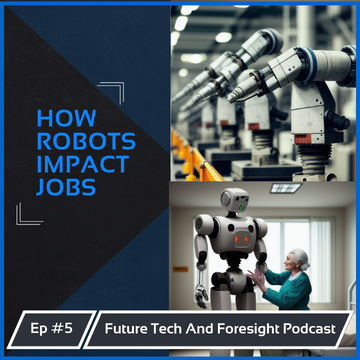


About The Episode
A First Look at robots and their impact on jobs. Industrial robots are looked at in part 1, Service robots will follow next week. Modern industrial robotics fit within the industry 4.0 trend and first generation robots have led to second generation collaborative robots (cobots).
Additional Notes:
Unimate Robot : https://robotics.kawasaki.com/en1/anniversary/history/history_01.html
Kawasaki robot : https://www.youtube.com/watch?v=t4yhjZ2koig
International Federation of Robotics : https://ifr.org/association
https://bruegel.org/2018/04/the-impact-of-industrial-robots-on-eu-employment-and-wages-a-local-labour-market-approach/
Part 2
The continuation of the exploration of robots and their impact on jobs. Service robots are looked at in this episode. They are broken up into 2 categories, professional and domestic and come in varied forms from AGVs, drones, surgical robots, vacuums etc.
Additional Notes:
-Amazon AGVs > https://www.youtube.com/watch?v=WzjzoJTkRmo
-Little Sunfish > https://www.youtube.com/watch?v=PbDmcmWjSp0
-Passive Exoskeletons > http://www.spexor.eu/2019/02/03/wearability-of-the-passive-exoskeleton/
-Boston Dynamics Atlas > https://www.youtube.com/watch?v=_sBBaNYex3E
-Boston Dynamics Spot > https://www.youtube.com/watch?v=wlkCQXHEgjA
Transcript Part 1
Before we jump into today’s topic which is going to look at robots and their relationship with our jobs, I wanted to briefly mention that as I’ve had some questions beyond the content of the episodes, if you want to reach out, you can via Twitter or Linkedin by searching for automated podcast. But let’s look at where robots came from.
History of Robots
Robots, or at least the idea of them have actually been around for a lot longer than some might think. In both Greece and China, as far back as 300 BC, both autonomous beings and animals were conceptualized. Much later, even Leonardo da Vinci in and around 1500 had sketches for a mechanical knight that would have been capable of very simple moments. But it wasn’t until 1921 that a Czech writer coined the term for a play, where the plot revolved around a man who makes a robot, and then is subsequently killed by it…not unlike many media productions today. the term robot itself comes from the Czech “Robota” meaning forced labour, which is especially fitting for our topic. However, Modern robots as we know today them didn’t come around till the middle of the 20th century when the first electric autonomous robots were made in England in 1948 by William Grey Walter and resembled slow moving turtles. Elmer and Louis simply prattled around and when their batteries ran low they were able to find their way to their charging station. But in 1954 in the USA George Devol made the first Industrial (or commercial digital and programmable) robot, which was sold to general motors in 1960. Unimate, the industrial robot, looked pretty similar to today’s industrial robots, though certainly less agile. It had a large base with an attached movable hydraulic arm with a gripper at the end which would be changed for different operations. I’ll put a picture in the shownotes. With this first robot’s adoption we can already see a glimpse of the value of robots in general – it was tasked with lifting hot pieces of metal and stacking them in the automotive manufacturing plant, as well as welding parts from an assembly line onto cars. This was actually quite a dangerous task for human workers who could be poisoned by the toxic fumes or even lose a limb. Robots have improved greatly since then, and though they are still predominately used in manufacturing, they have diversified extensively. The International Federation of Robots (IFR) (one of the many associations connecting robotic companies and researchers across the world) breaks robotics into 2 main categories, industrial and service. We’ll look at industrial robots in this episode and leave service robots for next time as they are significantly more diverse.
Industrial Robots
Though there are many variations of industrial robots, the classic and widely used form is an articulated robot. Multiple joints allowing it to move in many different angles, and most take the form of a single arm, similar to Unimate as mentioned before. Of course they are programmable and usually to do a specific task. There are five major markets for industrial robots: China, Japan, the United States, South Korea, and Germany. These countries account for 74% of global robot installations. But why exactly are robots so often used as the example of a technology when we have discussions about humans vs machines especially as it relates to Jobs? This is linked to a point from a previous episode, where technology has throughout history replaced human physical capability, and robots are perhaps the current best example of this. There are many aspects but it can be generally boiled down to three: speed, accuracy, and repeatability. To give you a bit of an idea of the differences, if you’re sitting down right now, try picking up your cell phone or any object in front of you, and put it down at your arms length. Now do this a few times rather quickly and try to put it down in the exact spot you put it down the first time. You might actually be pretty accurate and only be off by a few centimeters. Now. go ahead and do this 3000 times without stopping. I’d be willing to bet you’re probably a little less accurate as time goes on, and most probably not going to finish.When we talk of robotic accuracy we typically measure that accuracy in the millimetres, or fractions of millimetres, not centimetres. For speed, that motion you did or human motion speed, is generally considered to be done at a maximum of 1.6 m/s. Compare this with a new robotic example, where a Kawasaki robot can move over 12,000m/s. As for repeatability, 3000x, won’t even make the commercial robots break a sweat, with near perfect precision, at incredible speeds. Hopefully this gives a decent picture of basic industrial robot capabilities, there are lots more like the degrees of freedom it can move in, payload it can carry, not to mention the lack of need for breaks, or sick days, or holidays etc. For this reason it’s easy to understand that there are now some 2.5 million industrial robots in use across the world with over 400,000 being installed just last year. China has been the world’s largest buyer since 2013 and accounted for 36% of total installations in 2017 and 2018 with about, 154,032 installed each year. My goal here isn’t to bore you with stats of robots being bought but to give a picture of a growing trend, especially as most of us don’t work in a factory and don’t physically see these robots invading our workspace. But if you do, and are currently having one adopted I’d be very curious to hear about it! So what specific impact has this robotic invasion had on the manufacturing industry? As you can imagine, it has not been positive for human employees. Even though industrial robots can expand the need for employees by creating more efficiencies in production, in a report looking at robot adoption in the EU specifically was found that there is an overall decrease in workers when more robots are adopted. But this makes perfect sense, as outline before, workers are easily displaced from specific tasks that humans have no chance to compete against. The same has been happening in the USA but perhaps more starkly, as between 1980 and 2017 7.5 million manufacturing jobs were lost. Of course globalization and offshoring manufacturing to cheaper labour nations has a large part to play, but even those businesses that stay are no longer the same. Low-skilled work is not as in demand anymore, as it has continually being replaced by high-skilled labour (such as engineers, software developers, and computer programmers, – tasks that require more cognitive skill which industrial robots aren’t capable of automating- that’s the job for AI as mentioned in the previous episode but let’s not go back to that here).
Cobots
However, what has been described so far is relevant for the first generation of industrial robots. Since the turn of this decade a second generation of ‘collaborative robots’ has been on the scene which possibly turns this story around. One of the main problems with the first generation of robots is that they were deaf, blind, and dumb. The robots had to be put in a large mesh cage so as to not slam into human employees working in close proximity which has caused injuries, and even deaths., or the entire assembly line had to be redesigned to eliminate humans on a shop floor altogether requiring very expensive factory redesigns. But with the advent of cheaper and smaller sensory technology, the new generation of collaborative robots, or cobots is able to ‘sense’ their human co-workers nearby and either slow down their actions, or stop altogether if they feel physical contact. (another aspect is that they are typically very easy to programme as they shift between job tasks quite quickly). I was lucky enough to go to a conference a few years ago and actually programme one of these robots on the spot, with what was essentially a modified tablet, and was instructed to bump into the robot as it was picking up it’s little block and depositing them in an indicated bin. I held out my arm in the path of the cobot, and after it picked up it’s little block and moved towards the bin, it slowed down and stopped right after giving my arm a gentle bump. After I moved away it continued with the task I had given it. This is pretty impressive, especially this offers the ability for factory employees to remain on the factory floors, train them and work with them so the cobot takes over the more mundane and repetitive tasks. Though they are slower than the traditional robots they are still very precise. However cobots only make up roughly 1% of all industrial robots right now, but possibly by 2027 as much as 30% of new robots sold could be collaborative. With many other technologies, their implementation has been connected to the trend of -re-shoring- where companies are bringing their manufacturing processes back to industrialized parts of the world like the USA and Europe. This then increasing the amount of jobs within manufacturing in these parts of the world, and alters the skills needed of workers as cobots can undertake a number of the more repetitive tasks letting human workers focus on the things that are still challenging for robots and AI like quality control.
Industry 4.0
Though not objectively considered robotics, it would be amiss if I didn’t mentioned industry 4.0 in this topic. As many of you know we are now considered to be in the 4th industrial revolution which can be seen as the start of the blurring between the physical, digital and biological borders and this is underpinned by greater technological speeds than in the previous 3. A subset of this revolution is Industry 4.0 which specifically looks at industry and includes the connection between the industrial physical technologies like robots with digital ones, the cloud, big data, or the internet of things. This does however goes beyond the cobot sensors which can sense their nearby environment to avoid bumping into arms and causing injury. It can enable a business potential complete environmental awareness of an entire production process, enabling benefits like the replacement of machines before they wear out, find unknown inefficiencies, even remote management of a factory. this might however enable the first generation robots to be seen as a viable path of the future as human workers might interfere with a highly connected and digital process. Though there are various forecasts, It is still unknown whether cobots will overtake traditional robot adoption in the years to come, or with the linking of other industrial technologies pure automation of manufacturing will make more sense. If you have a strong point of view either way I’d like to hear what you think.
As always, Thanks for listening And make sure to subscribe and rate or review the podcast on iTunes if you have a minute. If you want to but aren’t a mac or iTunes user you can go to the website automatedpodcast.org and there is a quick guide to help you out on the blog page.
Transcript Part 2
In the last episode we looked at industrial robots – one thing that I came across during this past week relates to Foxconn, the Chinese iPhone manufacturer, and infamous for having suicide nets for its low paid workers. In 2011 they said they would have 1 million industrial robots in their facilities within 3 years, yet they seem to only have implemented some 40k, while retaining their 1 million workers. The CEO gave this reason, “The life cycle of consumer products like smartphones has become shorter and shorter, so it’s not cost-effective to spend money on a fully automated production line, “Humans are more flexible and cost-effective at a big number of workstations.” This is something that’s been tried before by other manufacturers—such as Fiat, Volkswagen, GM and most recently Tesla and they have all failed. Tesla which was planning to build a fully automated factory for its Model 3 explained that the troubles are because of the complexity of automating final assembly, where the car is put together “Automation simply can’t deal with the complexity, inconsistencies, variation and ‘things gone wrong’ that humans can,”. In final assembly, robots can apply torque consistently—but they don’t detect and account for threads that aren’t straight, bolts that don’t quite fit, fasteners that don’t align or seals that have a defect. Humans are really good at this. Humans are able to spot things that aren’t right, stop the process, and try to get them fixed. It would appear that full automation, though desirable by many of these companies is a ways away.
Service Robots
But today let’s look at service robots. These are broken into 2 groups, professional and domestic and both have quite a varied amount of robots in both group professional include: AGVs, drones, exoskeletons, defence, and medical. While Personal or domestic robots include: vacuum, lawn mowing, pool cleaning and entertainment such as toys, hobby systems, education and research, but we will just look at the main ones in this episode. Overall in 2018 around 275,000 professional service robots were sold, up from 170,000 in 2017. While in domestic it was over 16 million (predominantly robot vacuums) and it’s expected that both groups will continue to grow as the years go on. Though it’s highly possible to have an episode on each of these technologies, what might be more feasible is a general look at each of these techs and how each affect jobs. If however you feel this is too superficial, and want a more specific episode targeting one of these robots in particular, let me know either through twitter or Linkedin and I’ll make sure to do so if there is enough interest.
AGVs
Autonomous Guided Vehicles (AGV) are robots that typically follow floor sensors or wires placed on the ground for navigation. They generally consist of a base where products can be placed and have 4 wheels or tracks to move with. They are used mostly in logistics and manufacturing, but creeping more and more into last mile delivery. They are used in many applications such as moving pallets, being loaded with shipping containers, delivering raw materials in automotive factories but mostly are within warehouses to move products around. Much like industrial robots vs cobots, there is now a second generation of AGVs that have emerged over the last few years – autonomous mobile robot (AMR) which use radio waves, vision cameras, magnets, or lasers for navigation. Much like the cobot they are more flexible, intelligent, and cost effective as there is no need for an expensive wire system to guide them, the navigation system is built in. Yet today the term AGV now also applies to AMRs and they work in the same applications as AGVs but are now used more and more in hospitals where they can connect to and use elevators and doors to deliver bedding, meals, used food trays, etc. AGV’s makeup 41% of all service robots sold. The most well known AGV example is that of Kiva systems being bought by amazon in 2012 for their warehouses which actually sparked the AGV industry. Perhaps you’ve seen the videos of the small orange robots moving around lifting and moving amazon bins and resembling an ant hive where things are being moved constantly from place to place – if not one will be put in the shownotes. Utilizing AGVs can have some augmenting effects on human workers while the AGV carries the product reducing physical limitations and possible injuries of the human worker. However some interesting things can happen when they are applied in large groups, especially in warehouses. Lights out factories or dark warehouses exist where there is no need light, heating, or cooling as humans do not need to be constantly on the working floor. AGVs can scan and navigate in pitch black. This enables tremendous savings for a company enabling them to expand and grow and hire more people elsewhere for different tasks. Though it is excessively expensive and most attempts only go to some 80% where most of a warehouse does not have human activity.
Drones
The next tech to look at, drones, fit within a number of different sectors, inspection & maintenance, last mile delivery (soon personal transportation, but more on this next episode) and defence (only 5% of service robots sold in 2018 were in defence – I’m going to have a future episode dedicated to automation in the military so we won’t look at this here today). So looking at Inspection and maintenance within agriculture, AGVs are used for weed control, spraying, seeding etc, (some robot arms are used for picking), but drones are actually highly utilised within agriculture. They create a better picture of the state of a crop or field especially as many large fields are over 100 acres making it impossible to see the middle allowing a specific place to be harvested or sprayed. Feeds into the idea of precision farming which uses real-time data to make decisions, and maximize efficiencies and ultimately yields. This will not replace farmers at all, it is purely augmenting their capabilities and improves their decision making. The same is seen when used in infrastructure while also reducing injuries and decrease risks for people. Great example are the robots used in the Fukushima Daiichi reactor cleanup, though not aerial drones the purpose is the same underwater. The cleanup is still underway since the March 2011 earthquake and subsequent tsunami melted down 3 of the 6 reactors and it was only in July of 2017 that the melted nuclear fuel was first located by a shoe box sized remote robot called ‘little sunfish.” This is evidently a use case augmenting human personnel, rather than automation. As for last mile delivery, drones have the potential to radically transform the sector as well as the jobs within it. Labour is the biggest cost for last mile delivery and I have also heard that for the growing food/restaurant delivery industry, most if not all major delivery companies are not profitable due to these high labour costs of labour as well as the high perish-ability of the food. If you know for sure, please tell me. Same goes for the restaurants using this service but simply have to do this as delivery keeps growing as a preferred way to consume food. There is a pilot project in Iceland with an Israeli company Skytrex, that will have drones deliver various goods in people’s backyards. It has coverage to about half the city, if implemented entirely there will be no need for last mile delivery to be carried out by bike/scooter anymore, which is a growing job since the beginning of online delivery took off a few years ago. However, what is more interesting is the social benefit of drone use in disadvantaged parts of the world, where there is little to no access via road, or rail. Emergency and healthcare needs aren’t met because of this, but drone use can change this. Zipline is the world’s largest drone-delivery network that delivers vaccines, Medicine, blood, etc in Ghana to over 2500 health facilities which reaches over 20 million people. This is one of many examples out there but it’s easy to see that it can generate an entirely new delivery industry to support the bottom billion, both improving the quality of for millions while also creating local and international employment opportunities.
Exoskeletons
Moving onto exoskeletons, these are either powered or passive suits that are worn and act as augmenters to the wearer for various tasks. I went to a conference last year where a number of them were showcased, and tried on a passive one that used springs and pulleys to support my arms. It was easy to hold my arms either out in front of me or to reach up with minimal effort. Very useful for people who have to work overhead in manufacturing. These act simply as supporting employees and their jobs but doesn’t have any automation impact apart from allowing an individual to perform tasks for longer periods of time without being worn out or needing a second person to help with lifting something.
Medical
Referring back to the last episode’s discussion of the precision and repeatability of robotic systems. A surgeon’s tiring or shaking hand is quite a risk during a long operation, compared to the stable movement of a robot. Thus surgical robots have predominantly changed surgeries over the course of the last decades to allow minimal invasiveness, allowing patients to recover faster. Some examples where they are used are: cutting cancerous tissue- especially near blood vessels, nerves and organs, kidney removal, and coronary artery bypass. Needless to say it is also a growing industry with some 5000 sold last year.
Domestic Robots
Robot vacuum
11.6 million robot vacuums sold last year. I bought one this year, and it goes about it’s business by bumping into the walls to find the edges of my apartment. It actually kept bumping into my feet and chair as I was preparing this episode earlier today. But I can’t complain as it’s impact is similar to that of the dishwasher’s of the 1970’s. Instead of cleaning my floors, I’m able to spend more time on this podcast or be with friends etc. Personally, I’m looking forward to automating more parts of housework in the future, like by using Moley a set of robotic arms that can cook your meals, or Foldimate, a crowdfunded laundry folder. They aren’t commercially ready yet, but I’ll keep you posted if I come across new ones. Or, if you know of similar techs that are available right now, please let me know!
Robot lawn mower
Pretty self explanatory. I saw my first one 4 years ago while I was writing my master’s thesis in Oslo. Though I interviewed the ground staff and tried to incorporate the idea into my thesis it didn’t work so let me share a bit here. They operated a fleet of them as the university grounds were quite large. The 10 or so grounds staff were all very happy to have the robots as it enabled them to do other tasks that they weren’t able to get around to, or were more enjoyable. Nobody was fired as there wasn’t a dedicated lawn person, but then again, no extra people were hired to make up the slack.
Honourable mentions
As you can tell, there are so many robots that fit within the service category it’s impossible to get to all of them, but I wanted to very briefly talk about a few that didn’t fit in the previous sections:
Boston Dynamics – Not a drone but need to talk about perhaps the most famous robotics company Boston dynamics. They have multiple videos that have gone viral with the advanced acrobatic feats that their atlas robot can do. Another of their robots, Spot, only this past week has been made available to buy and does inspection in closed and controlled spaces.
Elder care robots – Japanese Robear – can lift patients from bed without human help. Frees up nurses and prevents injuries.
Conclusion
Service robots are exceptionally varied in type and application yet AGVs are the bulk of commercial adoption while their smaller home vacuums counterpart dominate the domestic market. Depending on which technology you look at and the way it is applied, potential for job augmentation or change is predominant among these types of automation technologies. But both AGVs and drones in particular have a greater capability to automate specific jobs if utilised at scale. That’s it for robots, next week we will look at autonomous vehicles.
As always, if you like the podcast and want to support it please leave a review and rating on Itunes or wherever you listen to your podcasts.